


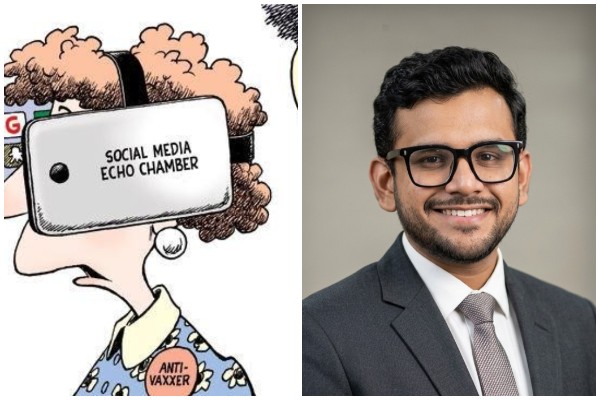
Have you ever noticed that your Facebook or Instagram feed often shows you posts that support exactly what you already believe? One post after another seems to agree with your opinions. It may feel as if the whole world thinks the same way you do. But that is not the reality. You may simply be living in a small digital world filled with information that matches your own views. This is what experts call an “Echo Chamber.”
Social media has created invisible walls around us. Its algorithms are designed to show us content based on our interests, preferences and previous online activities. As a result, we often have fewer opportunities to hear different opinions or face uncomfortable truths. Instead, we keep hearing our own beliefs repeated by others, slowly becoming more convinced that we are always right.
This growing problem has become one of the major challenges behind social intolerance and social division today.
Johan Galtung, widely known as the founder of modern peace research, explained that peace is not simply the absence of war or violence. It also means creating a society based on social justice, equality and mutual understanding. This idea is known as “Positive Peace.”
From this perspective, access to reliable information and the ability to think critically are essential for reducing conflict and building a more tolerant society.
The Department of Peace and Conflict Studies at the University of Dhaka and institutions such as the Centre for Peace and Justice at BRAC University are working to promote peace, justice and social understanding through research and academic activities. However, despite these efforts, meaningful social change remains difficult to achieve. A lack of personal responsibility, public awareness and proper digital literacy continues to stand in the way.
The consequences are already visible in our society.
A small personal disagreement on social media can quickly turn into group-based hostility or even religious conflict. In many cases, people rush to share emotional content without checking whether the information is true. False information can also provoke angry crowds, sometimes leading to attacks on innocent people. Such incidents expose the serious lack of digital awareness in our society.
Even more concerning is the behaviour of educated people. When people who are expected to think critically become involved in online trolling, hateful comments and the creation of divisive content, it raises serious questions about our intellectual responsibility.
Our unwillingness to accept different opinions has become one of the biggest dangers of digital echo chambers.
To address this growing crisis, we need changes at both academic and practical levels. Digital literacy and social media awareness should become an important part of modern education. Understanding how algorithms work, identifying misinformation and respecting different opinions should be basic skills for every internet user.
We can also turn the idea of Positive Peace into practical action in our daily digital lives.
Take Control of Your Algorithm: Make your social media feed more diverse. Follow people and platforms that offer different perspectives, including those that challenge your own beliefs. Disagreeing with someone does not make them your enemy. Learning to engage with different opinions can strengthen your ability to understand others.
Pause and Verify: Before sharing any news, image or video, take a moment to check its source and accuracy. Do not allow emotions to control your decisions. A few seconds of verification can prevent the spread of misinformation and unnecessary conflict.
Respond, Don’t React: Instead of responding to disagreement with personal attacks or hateful comments, try asking thoughtful and constructive questions. Remember, in the digital world, the power of an intelligent question is often greater than the impact of an angry response.
We have reached an extraordinary level of technological advancement, yet our way of thinking often remains trapped in the primitive idea of “Us versus Them.”
Our smartphones may be smart, but have we become smart enough in the way we use them?
Inside our digital echo chambers, we have become comfortable listening to our own voices. We accept information that supports our beliefs and often reject anything that challenges them. But a healthy society cannot grow through agreement alone. It needs open discussion, critical thinking and the courage to accept different perspectives.
We must remember that in a society divided by conflict, building peace requires more than the absence of violence. It requires the patience and willingness to listen to voices different from our own.
The real question is Do we still have the courage to face the truth, even when it challenges what we believe? Or will our virtual echo chambers become the only world we are willing to live in?
Abid Chowdhury, Student, Department of Peace, Conflict and Human Rights, University of Dhaka, Bangladesh