



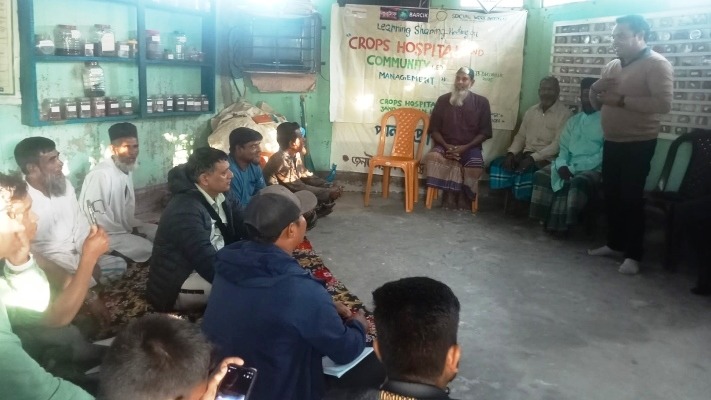
Staff Reporter: Like farmers in Bangladesh, Nepali farmers also survive by confronting various natural disasters such as drought, floods, lightning, pest attacks, hailstorms, heavy rains, excessive use of pesticides in agriculture, and cold injury. Therefore, farmers constantly adopt various adaptation strategies to meet their needs. Bearing these issues in mind, a team of development workers from Nepal came to observe the activities of the “Crop Hospital” and the “Poison-Free Village” initiative run by the Janounnayan Kendra in Shadhupara village of Tarakanda Upazila, Mymensingh district, Bangladesh.
A six-member team from the Social Work Institute of Nepal participated in an exchange meeting with the Shadupara Farmer’s Group, organized by the Shadupara Janounnayan Kendra and supported by BARCIK. Also present were Syed Ali Biswas, Director of BARCIK, Md. Ohidur Rahman, Regional Coordinator, and members of the farmers’ organization.
The Bangladeshi farmers explained to the Nepali development workers how they manage crops by preparing organic pesticides (bio-pesticides) to cure crop diseases and are using vermicompost made at home as an alternative to chemical fertilizers to establish a poison-free village. For the past five years, they have been tying pitchers on trees to protect birds and planting Jam (Black Plum) trees for bird food. They also highlighted the local climate disasters and the indigenous adaptation strategies they use to survive and cope with them. Similarly, the Nepali farmers shared their local climate disasters with the Bangladeshi farmers and described their own adaptation strategies for dealing with these crises.
The discussion covered various points, including the protection of local genetic diversity, drought-tolerant crop varieties, and, in addition to rice, cultivating drought-tolerant or short-duration crops that require less water, such as spices, oilseeds, maize, and pulses. Other points raised included establishing regional agreements for water sharing and information exchange with vulnerable countries like India and Nepal. They also stressed the need to strengthen diplomatic efforts to secure compensation for climate change losses and “climate funds” from developed countries.
Nepali development worker Laxmi Prasad Tatal said, “The agricultural problems faced by farmers are an intercontinental issue, a reflection of global climate change. A concerted effort by the local population, civil society, scientists, and international partners, alongside the government, is essential to tackle this. It is urgent to take effective measures now to build a sustainable and climate-resilient region.”
