
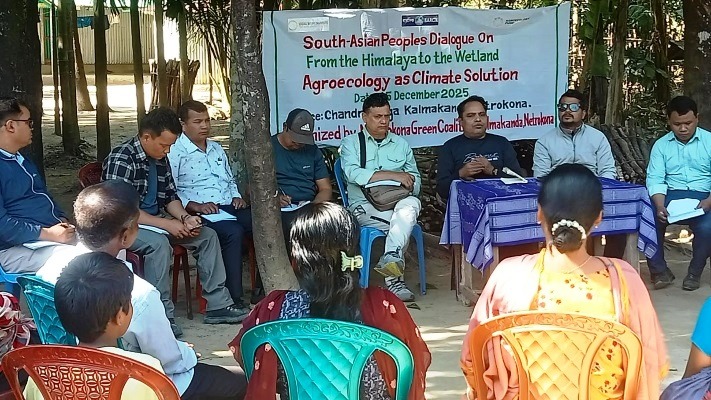
Staff Reporter: “South Asian Public Dialogue on Combating the Climate Crisis: From the Himalayas to the Haor”
For generations, people in the hills and haors (wetlands) of Netrokona have survived by managing drought, floods, early floods, hill torrents, hill sand deposition, storms (afal), lightning, heat, cold, and cold waves. Due to climate change, this crisis has significantly worsened for farmers. Practicing agroecology may be the only reliable way to combat the climate crisis extending from the Himalayas to the hills and haors of Bangladesh.
A public dialogue was held on Monday (December 14) at the Parimal Rema Agroecology Centre in Chandridinga village, a border area in the Kalmakanda sub-district of Netrokona district. The event was organised by the private research organisation BARCIK and the Green Coalition, with the participation of development workers from Nepal’s Social Work Institute and representatives of farmers from Bangladesh.
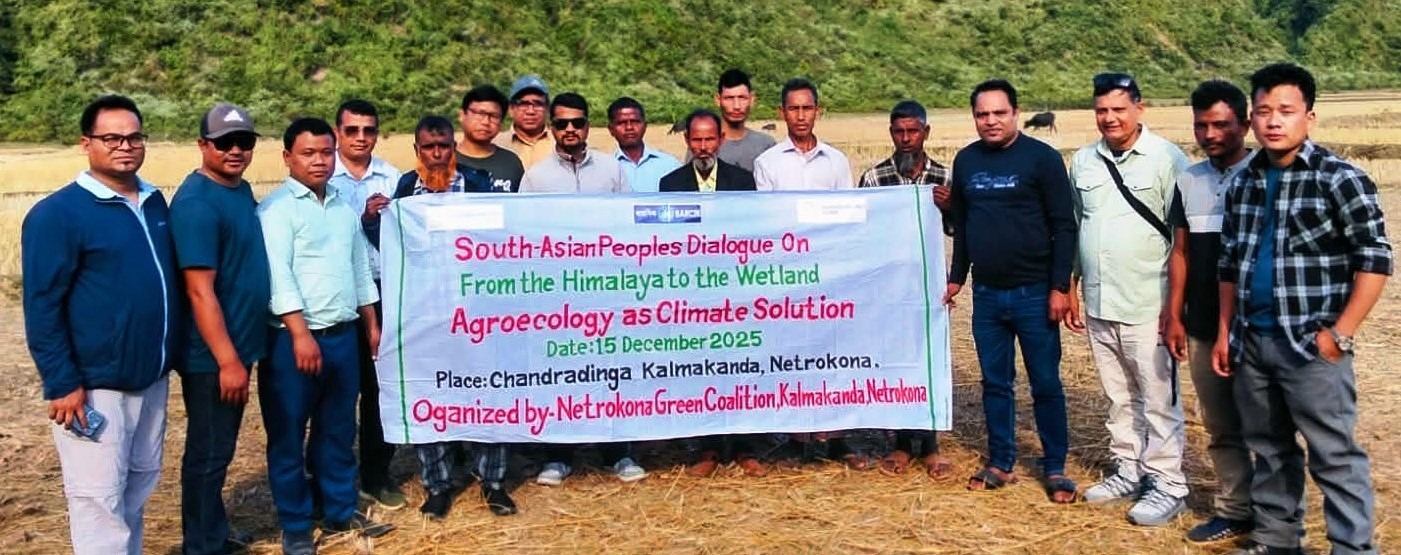
Six development workers from Nepal and Thirty one Bangladeshi farmers (both male and female) from the border region, along with BARCIK development workers, participated in the dialogue. Also present were Syed Ali Biswas, Director of BARCIK, Regional Coordinator Md. Ohidur Rahman, Gunjan Rema, and Md. Alamgir.
The farmers highlighted various problems, including hill torrents, sand, agricultural crises, and climate change. They also described the indigenous methods they use to address these issues and adopted plans for practising agroecology in their homes.
The problems raised were: Hill torrents and sand deposition, Lightning strikes, Market dependence for vegetables during the rainy season, Crop damage due to dense fog, Crop damage due to cold weather, Increased crop diseases and pests, Crop damage due to heat and heat waves, Unrestricted use of poisons, Scarcity of irrigation water.
Farmers in the hills provide irrigation during the Chaitra and Baishakh months (March-May) from water conserved in stream channels (chhara). Instead of chemical fertilisers, a small number of farmers use very small amounts of cow dung manure and vermicompost, prepare and use organic pesticides for crop diseases, and conserve seeds in their homes.
The Nepali delegation also shared various initiatives their country and farmers are taking to combat the climate crisis.