
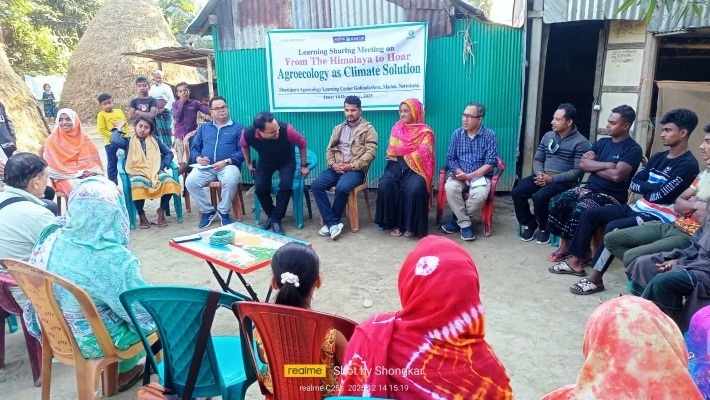
Staff Reporter: From the Himalayas to the Haor on Disaster Management meeting at shantipara, Madan, Netrakona.
The flow of water from the Himalayas causes sudden floods in the Haor region of Bangladesh, damaging the farmers’ dream crops, destroying homesteads, and filling up rivers and haors. The region is also a victim of river erosion and other natural disasters, which pose a threat to the agriculture and public life of this area. As a result, the farmers of the Haor consider local adaptation strategies to be their only reliance for coping with natural disasters. Hence, farmers constantly adopt various adaptation techniques for their needs. Farmers in Nepal also survive these disasters near the Himalayas. Keeping these issues in mind, a Nepalese’ team came to visit the adaptation strategies of the farmers of Talar Haor in Bangladesh and organized a joint meeting.
The event, organized by BARCIK with financial assistance from the donor organization Oxfam, included a visit to farmer Rahima Akter’s Agroecology Learning Center in Gobindashree Union, Modan Upazila, Netrokona District, and participation in a Haor farm workshop. A six-member SWI (social work institute)team from Nepal participated in this workshop and offered their opinions. They are laxmi prasad, Tek rawat, Namraj,Ramakrishna, resham,Keshav Raj. Fifteen male and female farmers from Madan Upazila also participated in the workshop. BARCIK Director Syed Ali Biswas, and Regional Coordinator Md. Ohidur Rahman,shongkar mrong were present there.
Bangladeshi farmers highlighted the climate disasters in the Haor areas and presented the local adaptation strategies they use to survive these disasters to the Nepalese teams. Similarly, Nepalese team presented the climate disasters in their area to the Bangladeshi farmers and described their adaptation strategies for coping with those disasters, such as establishing high and safe shelters for people and livestock during disasters.
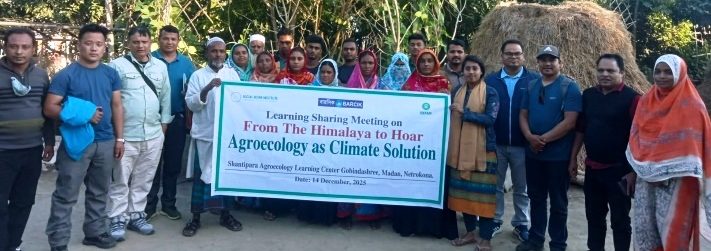
Key Discussion Points
The discussion also highlighted: Improving the drainage system by restoring river navigability and removing silt/sediment.
Cultivating water-tolerant crop varieties, along with Boro rice, such as spices, oilseeds, maize (corn), and pulses that are submergence-tolerant or have shorter production times.
Establishing regional agreements for water sharing and information exchange with affected countries like India and Nepal.
Strengthening diplomatic efforts to secure compensation for climate change damages and “Climate Fund” from developed countries.
“The disaster in the Haor is not just a local problem; it is a reflection of global climate change. Collective efforts from the government, local people, civil society, scientists, and international partners are lessential to cope with it. It is necessary to take effective measures now to build a sustainable and climate-resilient Haor region.”